
The Warning Sign in Your Bathroom Sink
Imagine if your scalp bled every time you brushed your hair, or your hands bled whenever you washed them. You would immediately consult a physician in alarm. Yet, millions of people worldwide rinse pink-tinted foam into their bathroom sink every morning and dismiss it as "just a little gum irritation" or the result of a stiff toothbrush.
In periodontology, there is a fundamental clinical rule: healthy gums never bleed during gentle brushing or flossing. Blood indicates an active bacterial infection and ulceration of the gingival sulcus—the delicate collar of tissue sealing your teeth to your jawbone.
The Disease Progression: From Gingivitis to Periodontitis
Understanding periodontal disease requires tracking how oral bacteria gradually compromise the structural foundation of your teeth:
Stage 1: Plaque Biofilm Accumulation
Within hours of brushing, a microscopic, sticky coating of saliva proteins and oral bacteria forms on the teeth (dental plaque). If not cleared daily with flossing and brushing, the bacteria metabolize dietary carbohydrates, producing chemical toxins that irritate adjacent gingival margins.
Stage 2: Gingivitis (Reversible Inflammation)
The immune system responds by flooding the gums with blood and defense cells. Gums become puffy, reddened, and bleed readily upon touch. Crucially, gingivitis is 100% reversible. At this stage, the underlying alveolar bone and periodontal ligament fibers remain completely undamaged.
Stage 3: Calculus (Tartar) Hardening
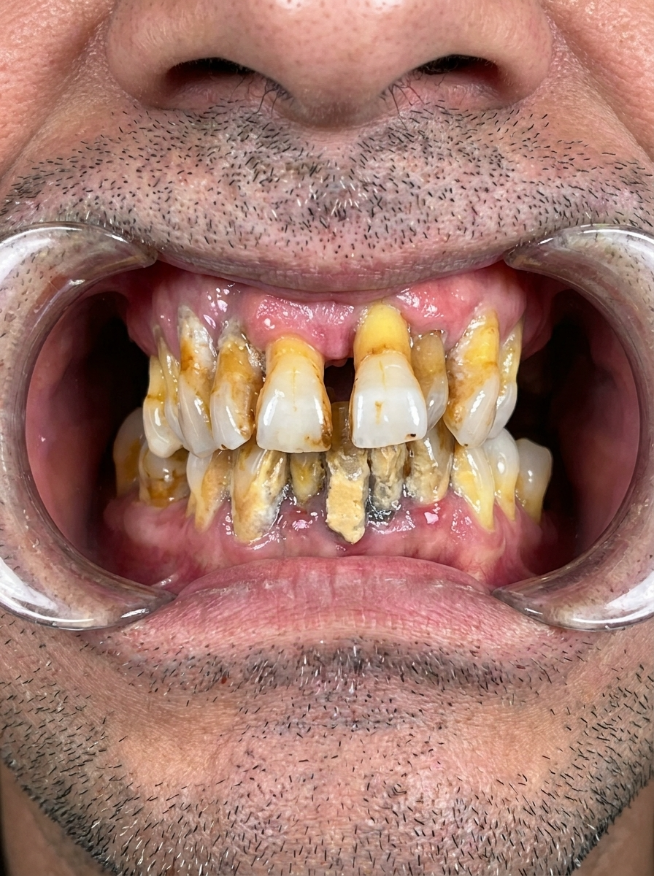
If plaque remains unremoved for more than 48 to 72 hours, minerals in your saliva crystallize into hard, chalky deposits called calculus or tartar. Calculus forms a rough, porous coral-reef-like surface below the gumline that cannot be removed by any toothbrush or floss; it requires professional ultrasonic instrumentation.
Stage 4: Periodontitis (Irreversible Bone Destruction)
As bacteria migrate deeper beneath hardened tartar, the chronic inflammatory response triggers osteoclasts to dissolve the alveolar jawbone supporting the tooth roots. Deep pathological pockets form between the tooth and the gum. As bone height recedes, teeth become mobile, shift position, and ultimately fall out or require extraction.
The Systemic Danger: How Gum Disease Affects Whole-Body Health
Periodontal disease is not confined to the mouth. The ulcerated surface area of deep periodontal pockets in an adult with moderate periodontitis is roughly equivalent to the surface area of the palm of your hand. Through these micro-ulcerations, oral bacteria (such as Porphyromonas gingivalis) and inflammatory cytokines enter the bloodstream 24/7:
- Cardiovascular Disease: Oral pathogens promote arterial inflammation, accelerating atheroma plaque formation in coronary vessels and doubling the risk of ischemic stroke and heart attacks.
- Diabetes Mellitus: Severe gum disease impairs glycemic control, increasing insulin resistance. Conversely, elevated blood sugar worsens periodontal bone loss—creating a dangerous bidirectional cycle.
- Adverse Pregnancy Outcomes: Periodontal pathogens can translocate to the placenta, linked clinically to low birth weight and preterm delivery.
- Respiratory Infections: Inhaling periodontal bacteria into the lungs increases the risk of aspiration pneumonia in vulnerable adults.
Clinical Periodontal Therapies: Reclaiming Gum Health
At KGH Dental, periodontal care is customized through thorough diagnostic pocket charting:
1. Ultrasonic Scaling & Subgingival Debridement
Using microscopic electromagnetic ultrasonic tips vibrating at 30,000 cycles per second, hardened supragingival and subgingival tartar is pulverized effortlessly while continuous sterile water flushes out bacterial colonies.
2. Root Planing (Deep Cleaning)
Under gentle local anesthesia, specialized micro-curettes smooth and detoxify the rough root surfaces beneath the gums, removing bacterial endotoxins and allowing the healthy gingiva to re-attach firmly to the tooth.
3. Laser-Assisted Periodontal Therapy & Regenerative Surgery
For deep periodontal pockets (6mm or greater), soft-tissue dental lasers decontaminate infected pocket walls with minimal trauma. In advanced cases, biocompatible bone grafts and enamel matrix proteins are placed to regenerate previously lost jawbone.
The At-Home Periodontal Maintenance Protocol
- Bass Brushing Technique: Angle your soft toothbrush bristles at 45 degrees toward the gumline to clean the gingival sulcus.
- Daily Interdental Cleaning: Toothbrush bristles only clean 60% of tooth surfaces. Daily flossing or interdental brushes are non-negotiable for the 40% between teeth.
- Maintenance Recalls: Patients with a history of periodontitis should attend periodontal maintenance checkups every 3 to 4 months rather than once a year.
Conclusion: Healthy Gums Are the Foundation of Every Smile
No matter how white or well-aligned your teeth may be, they cannot survive without a sound periodontal foundation. If you see blood when you brush, treat it with the medical urgency it deserves. Schedule an evaluation today to preserve your smile for life.
Medical Disclaimer & Clinical Review
All health content is medically reviewed by certified dental specialists at KGH Dental. Always consult a certified dentist for clinical diagnosis and customized treatment plans.