
The Consequences of a Missing Tooth Beyond Aesthetics
Losing a natural tooth—whether from untreated decay, severe periodontal breakdown, or sudden traumatic impact—sets off a cascade of destructive physiological changes within the oral cavity. While patients often notice the visible gap first, the most devastating consequences occur invisibly beneath the gumline.
Human jawbone requires continuous mechanical stimulation from natural tooth roots during chewing to maintain its density and height. Within the first twelve months following a tooth extraction, up to 25% of surrounding alveolar bone volume resorbs (melts away). As bone recedes, neighboring teeth tip inward into the vacant space, opposing teeth super-erupt downward, the bite collapses, and premature facial aging or sunken lips occur.
The Anatomy of a Modern Dental Implant
A dental implant restoration consists of three high-precision engineered medical components:
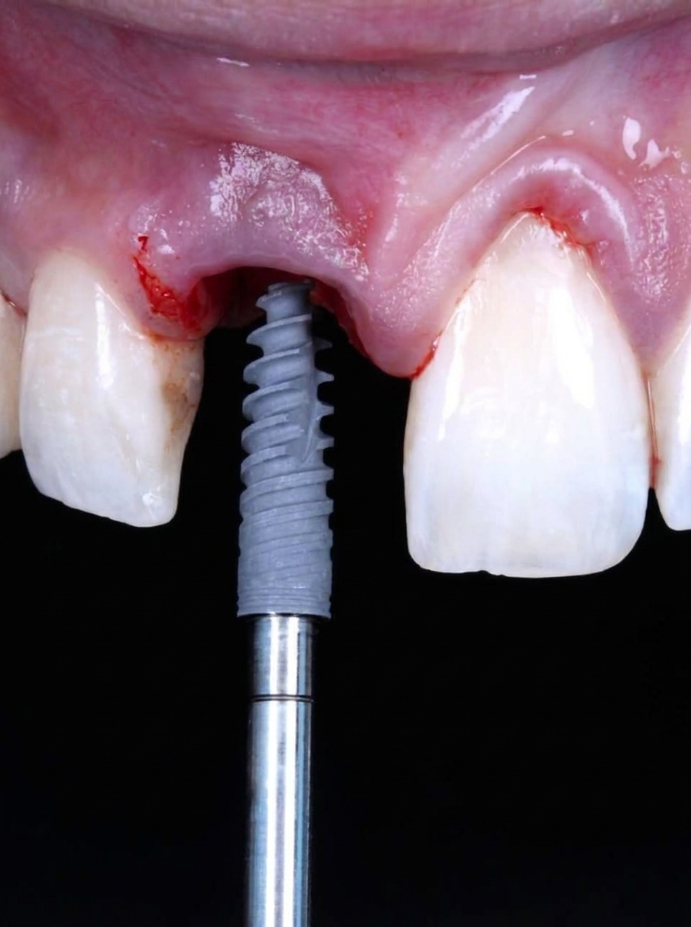
- 1. The Implant Fixture: A microscopic-threaded screw manufactured from commercially pure Grade 4 or Grade 5 medical titanium or zirconia. This acts as an artificial tooth root inserted directly into the jawbone.
- 2. The Abutment: A precision titanium or ceramic connector that screws securely into the implant fixture, emerging through the gum tissue to support the prosthetic tooth.
- 3. The Prosthetic Crown: A lifelike, custom-milled monolithic zirconia or layered porcelain restoration designed to match the shade, translucency, and contours of your surrounding natural teeth.
The Biological Miracle: Osseointegration
The monumental breakthrough of modern implantology was discovered in the 1950s by Swedish orthopedic surgeon Dr. Per-Ingvar Brånemark. He demonstrated that titanium is 100% biocompatible with living human tissue. Living bone cells (osteoblasts) do not reject titanium; instead, they grow directly onto the textured micro-porous surface of the implant, physically fusing it with the jawbone. This biological fusion is termed osseointegration.
Once osseointegration is complete, the titanium post can withstand the immense chewing forces of the human jaw—often exceeding 200 pounds of pressure per square inch—with the exact same stability as a healthy natural tooth root.
Why Implants Outperform Traditional Bridges and Dentures
Before implants, missing teeth were treated primarily with removable dentures or fixed dental bridges:
- Preserving Healthy Adjacent Teeth: A traditional three-unit bridge requires grinding away up to 50% of the healthy enamel and dentin on both adjacent teeth to serve as support pillars. If one supporting tooth decays years later, the entire bridge fails. An implant stands independently, requiring zero damage to neighboring teeth.
- Preserving Jawbone Architecture: Removable dentures sit on top of the gums and accelerate bone shrinkage through continuous friction. Implants stimulate deep bone regeneration.
- Chewing Comfort & Dietary Freedom: Dentures frequently slip, click, or cause painful pressure sores when eating apples, steak, or nuts. Dental implants restore 99% of natural chewing efficiency, allowing you to enjoy a completely unrestricted diet.
Am I a Good Candidate for Dental Implants?
Most healthy adults who have lost one or more teeth are outstanding candidates for implant therapy. Key clinical evaluation factors include:
- Adequate Bone Volume: You need sufficient bone height and width to encase the implant. If bone has shrunk due to long-standing tooth loss, modern guided bone regeneration (GBR) and sinus lift procedures can rebuild the lost bone architecture before or during implant placement.
- Healthy Periodontal Tissues: Active gum disease must be thoroughly treated and resolved prior to surgery to prevent bacterial infection of the implant (peri-implantitis).
- Controlled Systemic Health: Well-managed diabetes or hypertension is not a barrier to implants. However, heavy smoking or uncontrolled blood sugar can slow initial bone healing and require medical coordination.
The Step-by-Step Implant Treatment Journey
At KGH Dental, implant procedures are executed with digital surgical precision:
- 3D CBCT & Digital Intraoral Scan: Virtual computer planning simulates exact implant angle, depth, and distance from vital anatomical structures.
- Guided Surgical Placement: Using a 3D-printed surgical template, the titanium fixture is placed gently into the jawbone under painless local anesthesia. The procedure is typically faster and less traumatic than a routine tooth extraction.
- Healing & Osseointegration: Over a period of 8 to 12 weeks, the jawbone integrates firmly with the implant surface. In aesthetic zones, a temporary aesthetic tooth is provided so you never leave with a gap.
- Digital Impression & Crown Delivery: An optical digital scanner records the exact position of the abutment, and our dental laboratory mills a high-strength zirconia crown that seamlessly completes your smile.
Conclusion: An Investment in Your Health and Self-Worth
Dental implants are widely recognized as the single most predictable, durable, and physiologically natural tooth replacement procedure in modern healthcare. Reclaim your confident bite, clear speech, and youthful facial contours with specialist-led implant care.
Medical Disclaimer & Clinical Review
All health content is medically reviewed by certified dental specialists at KGH Dental. Always consult a certified dentist for clinical diagnosis and customized treatment plans.